

Site-specific installation, produced for the 2001 solo exhibition Deep Shadows? at Gallery 286, London, incorporates metal and holographic surfaces, electric light, and shadows cast onto the gallery floor.
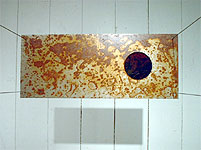
Title: Sight Lines
Date: 2001
Size: Gallery installation: H 2.85m x W 5.2m x D 1.3m
Materials: Reflection hologram on glass, metal, cable, digital prints
Edition: Unique
Collection: Produced for the solo exhibition Deep Shadows? at Gallery 286, London, UK in 2001
Pepper has become known for his graphic-based ‘drawn’ holograms where parts of the holographic images are often ‘scratched’ away, allowing light to pass through them and ‘draw’ a new image on the wall behind, or allow colour from the gallery wall to be seen through the holograms. In recent years he has been using smaller and smaller sections of holographic material to add a dimensional and kinetic element to his installations.
Work in Deep Shadows? follows on from earlier installations where glass holograms have been mounted directly into the plaster of gallery walls so that they protrude (unframed) to cast a shadow down the wall and onto the floor. These Wall Drawings have been installed in exhibitions in Madrid, Spain; Coventry, UK; Pulheim, Germany; and Canton, USA.
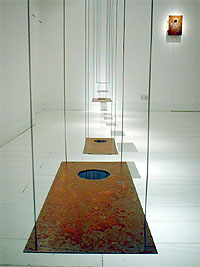


Each of the nine metal plates, containing small circular holograms, hangs from the gallery ceiling on four fine metal cables. The plates are suspended at slightly different heights to create a gentle ‘wave’ traversing the space.
The final plate extends into the gallery wall suggesting the installation continues into the adjoining room, and ultimately, perhaps, underground across west London, where the gallery is located.
Each plate and hologram is individually illuminated from above, reconstructing the holographic image and casting a shadow onto the floor.
Each metal plate was photographed; a thin strip from the centre of each image was digitally printed and mounted on the wall behind its respective plate.
These strips occupy the traditional ‘point of viewing’ for gallery works – mounted at eye height, where viewers might expect the holograms to be.
Although viewers may move between the hanging structures to view the prints, few felt comfortable doing so.
By relocating the holograms off the wall and into an unfamiliar suspended position, the installation acts as a barrier to more conventional viewing of the wall-based works.
In each wall-mounted print, the section depicting the holographic image has been removed.
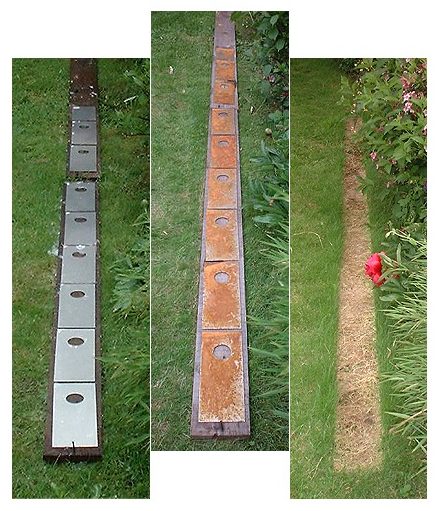
Preparation of the metal panels used in Sight Lines.
An outdoor rusting process took several weeks until the desired (random) marks were visible.
Once the rusting was complete, the plates were removed from their outdoor location (a domestic lawn) for the fitting of the holograms and drilling of the holes for the hanging cables.
While the metal plates have ‘moved on’ to become an installation in a London gallery, they have left a shadow of their presence on the lawn, by depriving the grass of sunlight for several weeks.
Both of these constructed and artificial ‘lines’ existed simultaneously, but in different forms and different locations during the exhibition.
By the time the exhibition closed and the installation was removed, the grass had recovered, offering no lasting indication of the line having been there in the same way that the gallery offered no indication of the installation having been installed.
Both exist only as memories and photographs.