
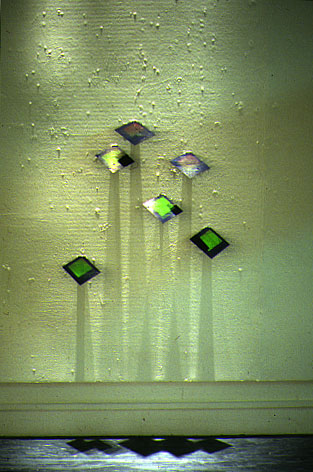
Reflection holograms are often framed in a manner which resembles more traditional graphics, paintings, or prints. This is a practical solution for presenting this type of work, but it also connects with a subliminal vocabulary about how the frame informs our view of the work.
The frame can suggest a state of ‘being finished’, a definition of the edge beyond which the work does not extend, or it can emphasise the picture plane and the flatness of the image surface.
Wall Drawing attempts to question that approach by using the gallery wall as the support for each unframed hologram. The glass plates support themselves as they protrude from small channels cut into the gallery wall.
Title: Wall Drawing
Date: 1998
Materials: 6 reflection holograms on glass embedded into the gallery wall
Edition: Unique Size: Gallery wall.
Site-specific work installed at the Lanchester Gallery,
Graham Sutherland Building, University of Coventry, UK, as part of a solo exhibition
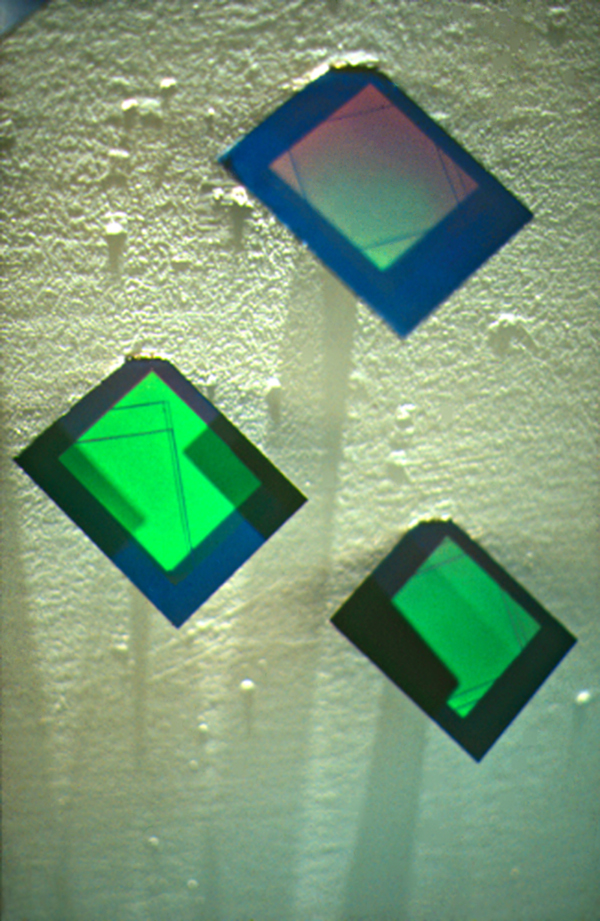
Each hologram contains the shadow of lines describing a rectangle or part of one. The lines appear to be above the holographic plate.
As an observer moves past the installation, these lines shift through vertical and horizontal parallax.
Spotlights on the wall above shine down to illuminate each hologram and cast a shadow of each down the wall and onto the gallery floor below.
A series of ‘virtual’ plinths appear to support each of the luminous works.

Graphics? Sculpture? Flat? Three-Dimensional?
