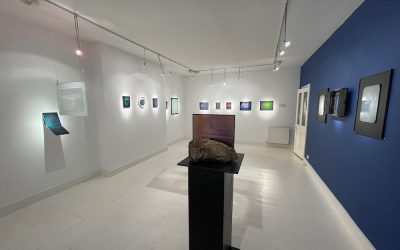
The Volume of Light
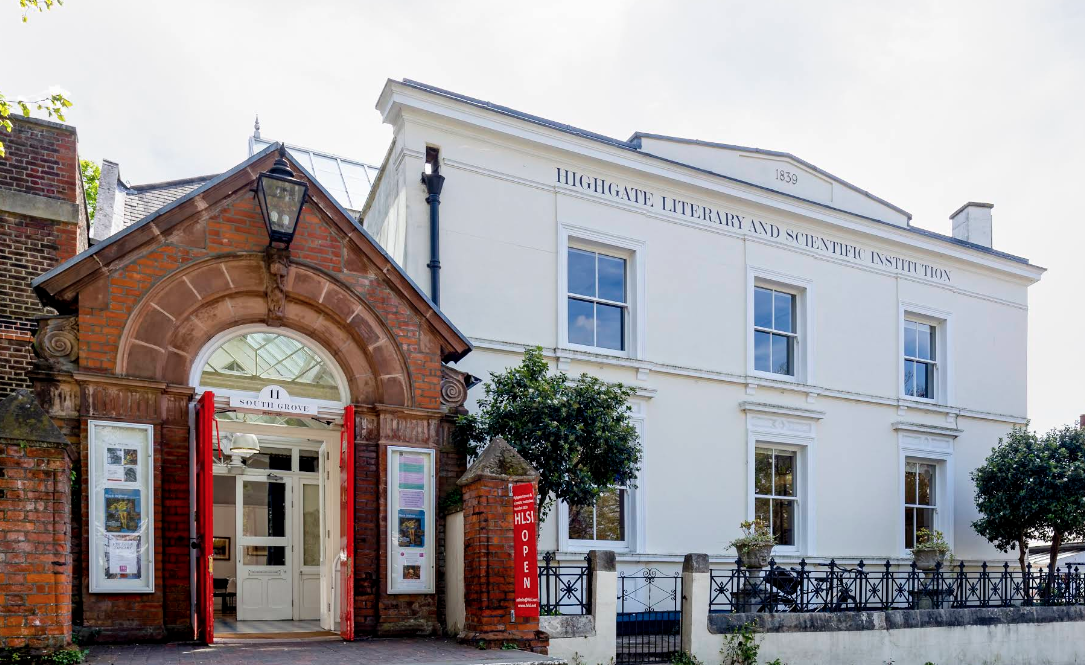
Highgate Gallery, London, UK
8 – 21 January 1999
Like almost everyone, I was attracted to holography because of the unfathomable three-dimensional reality of the images it recreated. At the time, as an art student producing light sculptures and environments, it appeared to offer the opportunity to document, in 3-D, the transient work I was making. The aim was to produce a holographic portfolio of my light sculptures, which I could show to galleries, collectors, and funders. It transpired that my expectations, like most people’s, were well beyond the capabilities of the medium.
I was eventually taught how to make holograms by artists who were already expert in the medium (and pioneers in their own right). Their practicality and sensitivity to creative needs helped me begin to understand what holography could offer. It was a long time before I produced holograms that I felt comfortable exhibiting. I needed to find a way of expressing my ideas that was not totally grounded in the 3-D cleverness so much a part of holography.
There has been a tendency in creative holography to concentrate on the issue of perfection – clean surfaces, blemish-free recordings – qualities that I found too clinical for my own work. I began introducing ‘blemishes’ into the process of making, (analogous to the ‘hair’ in a film projector gate, an irritating intrusion to distract from the purity of the images being shown). In extreme cases, this has resulted in entire sections of the holographic surface being removed, ‘scratched’ away, leaving a hole through which the wall behind can be seen. Light shining onto the hologram to ‘recreate’ the image it holds passes through these contrived, graphic imperfections to the wall behind and ‘draws’ a new image there. The resulting images are therefore on, in, and behind the hologram – they exist on more than one physical level, where they react to the movement and viewpoint of an observer.
Many of these ‘drawings’ consist of shadows ‘released’ from the surface of the holographic plate. They exist in ‘our space’ – the one between us and the hologram, and become displaced as we move past them. Perhaps it is easier to ‘see’ past these holographic images to the content, concerns, and possible passions which generated them.
Andrew Pepper, 1999
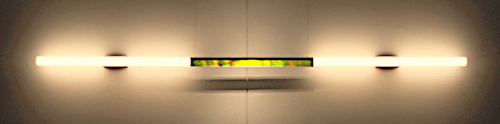
Divided Line. The central holographic image is ‘held’ in place by two incandescent light strips. A coat of arms for the Twentieth Century?
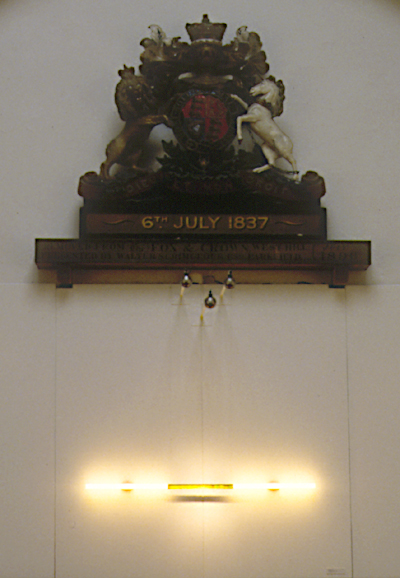
Divided Line, 1999. Site-specific installation in response to the coat of arms which permanently occupies one of the exhibition walls.
Works on show:
Drawing Series (5 holograms) 1987
Tail Segment 1990
Centre Level 1989
Corner Level 1989
Link 1990
Ripped Circle (shaded) 1990
Liquid Circle (2 holograms) 1998
Horizontal Corner 1990
MVF 1990
Square Eclipse 1989
Ripped Drawing (shaded) 1989
Cut Corner 1989
Mapping 1 1990
Overshadowed 1990
Colour Study 1993
Divided Line 1999
ActionAid 1987
Drawn Cube 1985
The energy that the introduction of new media and technology engenders in artist and public alike is great. The excitement generated can be an infusion of life and incite critical perception across a wider spectrum of art than the area of the innovation itself. It is among the special gifts to the continuing present that shows that activities in many fields can contribute to the progress of each other. It is equally important for each generation to believe, and discover, that the heights of human endeavour and expression are not only to be found in the past. Equally, of course, no new means in itself obviates the need for new work to be subjected to the degree of critical scrutiny that is developed by exposure to the art of yesterday. The idea that the ‘new’ is necessarily important and profound is as delusory as the idea that the methods of the past
are the only road to serious work.
Where does the work of Andrew Pepper stand in all this? Holograms do extend the means by which the dimensions of space and movement are revealed on or “in’ a flat surface. Often the effect is so surprising that maker and viewer seem to remain locked in brilliant ‘facts’, leaving the depths untouched. It is asking a great deal of an artist that they surmount this seduction by using these means as a servant to the essential idea, but in the end we ask just that and it is this that Andrew Pepper does. The sheer lack of pretension in his work is refreshing. He ‘draws’ with his medium intimately and acutely. The results are very beautiful. They give much pause for thought and contemplation beside any subsidiary explanation that may arise out of the technology.
The opinion of the professional world of holography needs no further elaboration than is revealed by his CV. That his work as an artist is so unpretentiously vivid is a lovely confirmation that character and artistic achievement can be so closely correlated.
Richard Robbins

Exhibition Reference
Date: 8 – 21 January 1999
Title: The Volume of Light
Location: Highgate Gallery, London, UK
Notes: Solo exhibition