

This work marks the first time Pepper used a digital holographic production process.
The image-object within the holographic plate initially existed as a series of points within a digital 3D modelling system. That data was sent to a holographic production Zebra Imaging in the USA, and the finished ‘printed’ hologram arrived by courier a few days later.
The resulting physical hologram, printed onto a plastic substrate, was produced as a test or sketch towards the end of 2013. It offered an opportunity to explore a digital production and visualisation process, continuing Pepper’s investigation into how the location of dots of light can define a volume.
Exhibited in Drawology, Lanchester Gallery, Coventry University, UK.
Title: Lean
Date: 2014
Dimensions: Hologram H 25.4 x W 20.32cm (H 10 x W 8 inches)
Gallery floor/wall (variable)
Materials: Digital hologram and shuttered theatrical spotlight

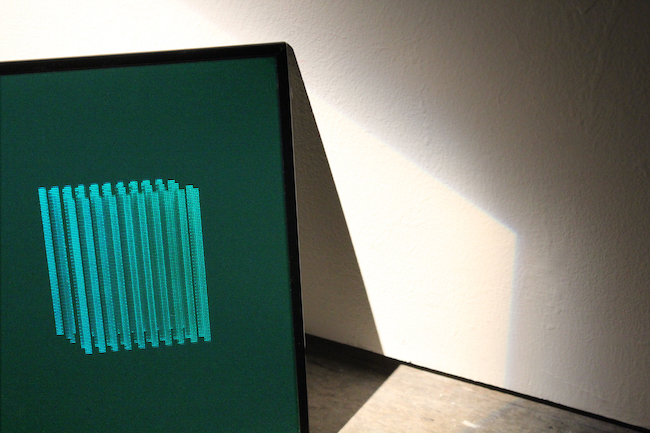
The work reiterates aspects of Pepper’s hand-drawn series from the late 1980s and early 1990s, made up of multiple, individual points of light – here rendered as ‘hogels’, the holographic equivalent of pixels. There is a direct connection between this digital work and Point Addition, which uses larger points of light separated into five distinct spatial levels.
Like many of Pepper’s works, Lean remained in the studio for some time before being incorporated into an installation. It was not until the summer of 2014 that this first digital experiment became one of the key elements within the Lean installation.
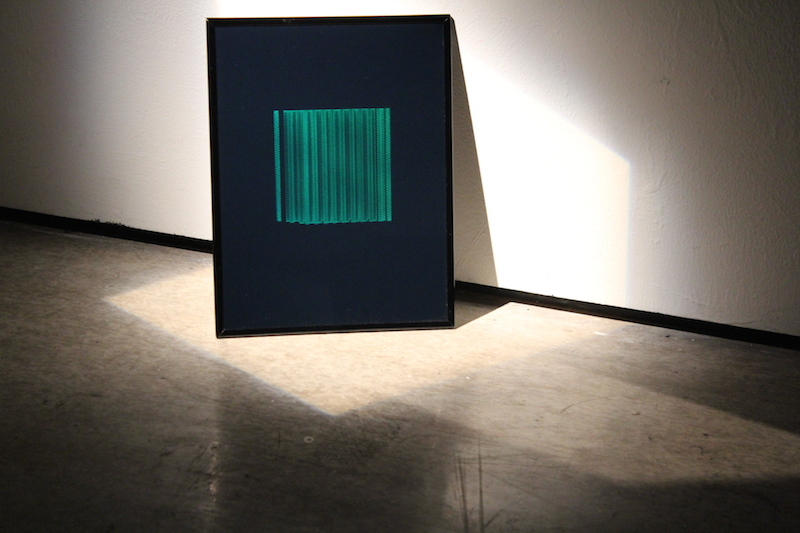
During the Summer Lodge research residency at Nottingham Trent University , an annual event offering artists space to experiment and collaborate, Pepper explored large gallery and workshop environments using theatrical lighting. It was during this residency, in July 2014, that the combination of positioning, lighting and angled display was developed.
Lean was shown for the first time in Drawology at the Lanchester Gallery, Coventry University, UK.


The holographically generated image is not immediately visible when approaching the work. Attention is first drawn to the flatness of the rectangular surface leaning against the wall and to the shadows it casts.
An act of spontaneous placement, propped up ‘on the way’ to the gallery wall, yet installed with conviction.
The work’s marks are framed both by their location and by the rectangle of light that makes the image visible.
